
Protein Molecular Weight Markers

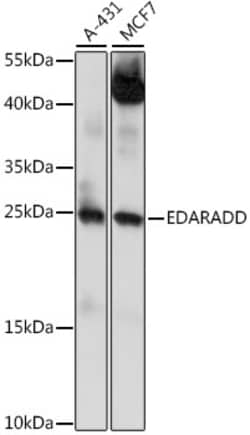
ABclonal Technology EDARADD Rabbit pAb

This gene was identified by its association with ectodermal dysplasia, a genetic disorder characterized by defective development of hair, teeth, and eccrine sweat glands. The protein encoded by this gene is a death domain-containing protein, and is found to interact with EDAR, a death domain receptor known to be required for the development of hair, teeth and other ectodermal derivatives. This protein and EDAR are coexpressed in epithelial cells during the formation of hair follicles and teeth. Through its interaction with EDAR, this protein acts as an adaptor, and links the receptor to downstream signaling pathways. Two alternatively spliced transcript variants of this gene encoding distinct isoforms have been reported.


ABclonal Technology DNER Rabbit pAb
Predicted to enable Notch binding activity. Involved in central nervous system development. Located in dendrite, early endosome, and plasma membrane.

ABclonal Technology ELOVL5 Rabbit pAb
This gene belongs to the ELO family. It is highly expressed in the adrenal gland and testis, and encodes a multi-pass membrane protein that is localized in the endoplasmic reticulum. This protein is involved in the elongation of long-chain polyunsaturated fatty acids. Mutations in this gene have been associated with spinocerebellar ataxia-38 (SCA38). Alternatively spliced transcript variants have been found for this gene.
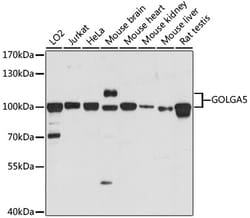
ABclonal Technology GOLGA5 Rabbit pAb
The Golgi apparatus, which participates in glycosylation and transport of proteins and lipids in the secretory pathway, consists of a series of stacked cisternae (flattened membrane sacs). Interactions between the Golgi and microtubules are thought to be important for the reorganization of the Golgi after it fragments during mitosis. This gene encodes one of the golgins, a family of proteins localized to the Golgi. This protein is a coiled-coil membrane protein that has been postulated to play a role in vesicle tethering and docking. Translocations involving this gene and the ret proto-oncogene have been found in tumor tissues, the chimeric sequences have been designated RET-II and PTC5. A pseudogene of this gene is located on the short arm of chromosome 5.
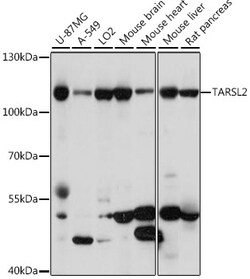
ABclonal Technology TARSL2 Rabbit pAb
Predicted to enable threonine-tRNA ligase activity. Predicted to be involved in threonyl-tRNA aminoacylation. Predicted to be located in cytoplasm and nucleus.
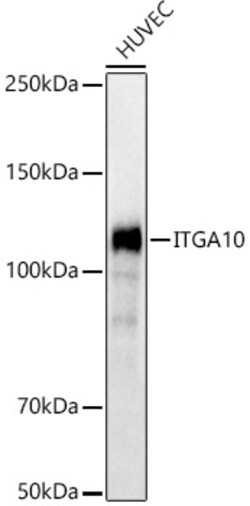
ABclonal Technology ITGA10 Rabbit pAb
Integrins are integral transmembrane glycoproteins composed of noncovalently linked alpha and beta chains. They participate in cell adhesion as well as cell-surface mediated signalling. This gene encodes an integrin alpha chain and is expressed at high levels in chondrocytes, where it is transcriptionally regulated by AP-2epsilon and Ets-1. The protein encoded by this gene binds to collagen. Alternative splicing results in multiple transcript variants.
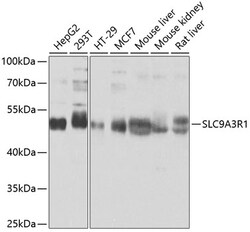
ABclonal Technology SLC9A3R1 Rabbit pAb
This gene encodes a sodium/hydrogen exchanger regulatory cofactor. The protein interacts with and regulates various proteins including the cystic fibrosis transmembrane conductance regulator and G-protein coupled receptors such as the beta2-adrenergic receptor and the parathyroid hormone 1 receptor. The protein also interacts with proteins that function as linkers between integral membrane and cytoskeletal proteins. The protein localizes to actin-rich structures including membrane ruffles, microvilli, and filopodia. Mutations in this gene result in hypophosphatemic nephrolithiasis/osteoporosis type 2, and loss of heterozygosity of this gene is implicated in breast cancer.
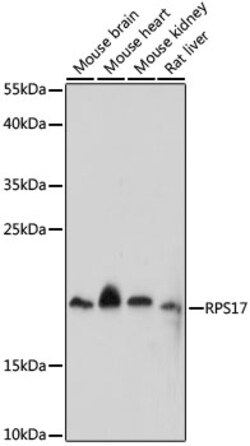
ABclonal Technology RPS17 Rabbit pAb
Ribosomes, the organelles that catalyze protein synthesis, consist of a small 40S subunit and a large 60S subunit. Together these subunits are composed of four RNA species and approximately 80 structurally distinct proteins. This gene encodes a ribosomal protein that is a component of the 40S subunit. The protein belongs to the S17E family of ribosomal proteins and is located in the cytoplasm. Mutations in this gene cause Diamond-Blackfan anemia 4. Alternative splicing of this gene results in multiple transcript variants. As is typical for genes encoding ribosomal proteins, there are multiple processed pseudogenes of this gene dispersed through the genome.
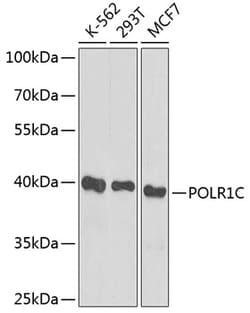
ABclonal Technology POLR1C Rabbit pAb
The protein encoded by this gene is a subunit of both RNA polymerase I and RNA polymerase III complexes. The encoded protein is part of the Pol core element. Mutations in this gene have been associated with Treacher Collins syndrome (TCS) and hypomyelinating leukodystrophy 11. Alternative splicing results in multiple transcript variants.
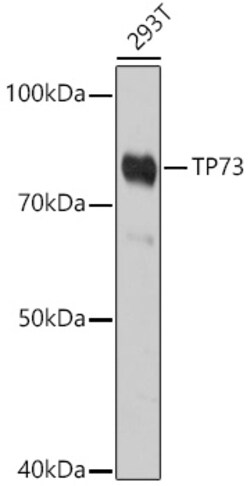
ABclonal Technology TP73 Rabbit pAb
This gene encodes a member of the p53 family of transcription factors involved in cellular responses to stress and development. It maps to a region on chromosome 1p36 that is frequently deleted in neuroblastoma and other tumors, and thought to contain multiple tumor suppressor genes. The demonstration that this gene is monoallelically expressed (likely from the maternal allele), supports the notion that it is a candidate gene for neuroblastoma. Many transcript variants resulting from alternative splicing and/or use of alternate promoters have been found for this gene, but the biological validity and the full-length nature of some variants have not been determined.

S2 Media 15x100mm Chameleon™ COLOREX™ VRE (RUO), 10/pack
Chameleon™ COLOREX™ VRE (RUO) is a selective and differential chromogenic medium used for the qualitative direct detection of VanA/VanB Vancomycin Resistant Enterococcus (VRE). Test specimens include rectal swabs and stools. For Research Use Only (RUO). Not for use in diagnostic procedures unless Laboratory Developed Test (LDT) validation with the product has been completed. Further identification, susceptibility testing, and epidemiological typing should be performed on suspect colonies.• Product meets CLSI performance criteria.• Chameleon™ COLOREX™ VRE should be used by trained professionals within a laboratory setting. • For in vitro diagnostic (IVD) use.• Product is not intended for use in the diagnosis or treatment of disease or other human conditions.
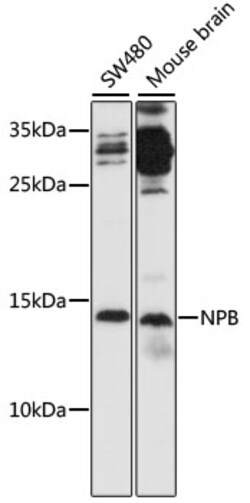
ABclonal Technology NPB Rabbit pAb
This gene encodes a member of the neuropeptide B/W family of proteins and preproprotein that is proteolytically processed to generate multiple protein products. The encoded products include neuropeptide B-23 and a C-terminally extended form, neuropeptide B-29, which are characterized by an N-terminal brominated tryptophan amino acid. Both of the encoded peptides bind with higher affinity to neuropeptide B/W (NPB/W) receptor 1 compared to the related NPB/W receptor 2. These peptides may regulate feeding, pain perception, and stress in rodents.
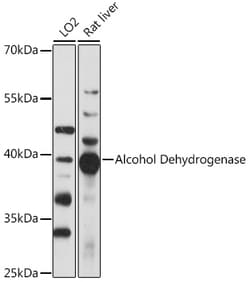
ABclonal Technology Alcohol Dehydrogenase Rabbit pAb
This gene encodes a member of the alcohol dehydrogenase family. The encoded protein is the alpha subunit of class I alcohol dehydrogenase, which consists of several homo- and heterodimers of alpha, beta and gamma subunits. Alcohol dehydrogenases catalyze the oxidation of alcohols to aldehydes. This gene is active in the liver in early fetal life but only weakly active in adult liver. This gene is found in a cluster with six additional alcohol dehydrogenase genes, including those encoding the beta and gamma subunits, on the long arm of chromosome 4. Mutations in this gene may contribute to variation in certain personality traits and substance dependence.
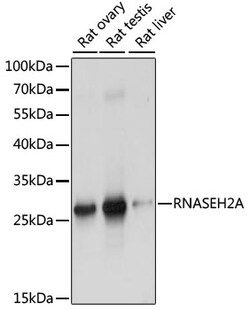
ABclonal Technology RNASEH2A Rabbit pAb
The protein encoded by this gene is a component of the heterotrimeric type II ribonuclease H enzyme (RNAseH2). RNAseH2 is the major source of ribonuclease H activity in mammalian cells and endonucleolytically cleaves ribonucleotides. It is predicted to remove Okazaki fragment RNA primers during lagging strand DNA synthesis and to excise single ribonucleotides from DNA-DNA duplexes. Mutations in this gene cause Aicardi-Goutieres Syndrome (AGS), a an autosomal recessive neurological disorder characterized by progressive microcephaly and psychomotor retardation, intracranial calcifications, elevated levels of interferon-alpha and white blood cells in the cerebrospinal fluid.
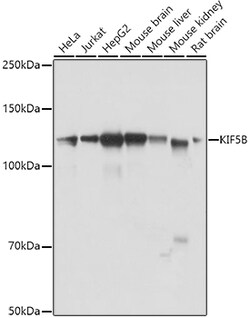
ABclonal Technology KIF5B Rabbit pAb
Enables identical protein binding activity, microtubule binding activity, and microtubule motor activity. Involved in several processes, including lysosome localization, natural killer cell mediated cytotoxicity, and positive regulation of protein localization to plasma membrane. Located in centriolar satellite, cytosol, and vesicle.